
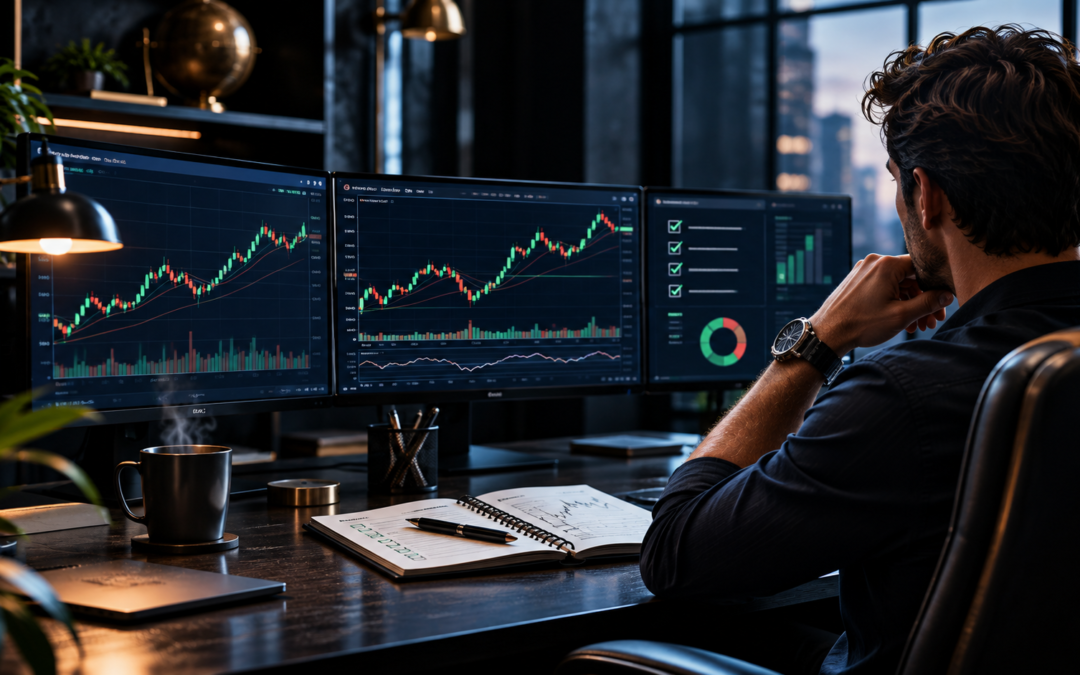
The Blueprint of Success: Why Trading Systems and Discipline Trump Emotion
In the high-stakes environment of financial markets, the promise of quick wealth attracts thousands of aspiring traders every day. Armed with ambition, capital and access to trading platforms, newcomers enter the worlds of stocks, forex and cryptocurrency, often believing that intelligence alone will lead them to profitability.
Yet the reality is considerably more challenging. The majority of retail traders struggle to achieve consistent results.
The difference between a trader who repeatedly loses money and one who develops consistent trading habits rarely comes down to intelligence or access to advanced technology. Instead, it rests on two fundamental pillars: a structured trading system and unwavering discipline.
Trading without a system is little more than expensive gambling. Operating a system without discipline is like building a race car and handing the steering wheel to a blindfolded passenger.
Understanding why structured rules matter, and why discipline is essential to executing them, is fundamental to anyone serious about long-term participation in financial markets.
Part 1: The Illusion of Discretionary Trading and the Need for a System
Human beings are natural storytellers. We look at a chart, identify a pattern and immediately construct a narrative explaining why the price is moving.
This discretionary approach to trading involves making buying and selling decisions based on intuition, gut feeling or real-time news headlines. It can feel empowering, giving the trader the impression that they are actively anticipating and responding to the market.
In reality, discretionary trading without a predefined framework can become a psychological minefield.
Without objective rules, traders are forced to make countless subjective decisions under conditions of uncertainty and financial risk.
What Is a Trading System?
A trading system is an objective, rules-based framework designed to remove ambiguity from the decision-making process.
It explicitly defines three essential components:
1. The Setup (Entry)
Clearly established criteria determining when to enter a long or short position. This removes guesswork and ensures that trading decisions follow a predefined strategy.
2. The Exit (Take Profit)
Defined exit parameters that establish when and under what conditions profits should be taken.
3. Risk Management (Stop Loss)
Predetermined invalidation levels that establish how much capital is exposed to risk on an individual trade.
Together, these components create a repeatable framework that allows traders to approach the markets with greater structure and consistency.
Why a Trading System Matters
Objectivity Over Emotion
Markets do not care about your hopes, fears or financial needs.
A quantitative or rules-based trading system responds to predefined market conditions rather than emotional impulses. This helps filter out the psychological turbulence created by fear and greed.
Backtesting and Statistical Edge
A properly developed trading system should demonstrate a measurable statistical advantage through historical testing.
Understanding how a strategy has performed across a sufficiently large sample of historical trades can provide a more objective basis for evaluating its potential.
Knowing that a strategy has demonstrated positive expectancy over a series of trades can also help traders maintain perspective during inevitable periods of short-term losses.
Repeatability and Scalability
You cannot reliably measure or scale a gut feeling.
A structured trading system can be measured, audited, evaluated and refined. Depending on the strategy, aspects of its execution may eventually be automated.
It transforms trading from an inconsistent, subjective activity into a more systematic business operation.
Part 2: The Core Component – Why Discipline Is Everything
Having a well-developed trading system is only half the battle.
A Ferrari parked in a garage is useless if the driver refuses to steer. Discipline is the bridge between a theoretical trading strategy and its actual execution.
Trading discipline is not about eliminating fear or temptation. It is about following established rules despite how you feel in the moment.
1. Executing the Plan When It Feels Uncomfortable
Some trading opportunities can feel particularly uncomfortable to execute.
Buying after a significant market sell-off, when financial media outlets are warning of further declines, may require considerable confidence in a tested strategy.
Conversely, taking a short position during a strong upward market movement can feel unnatural when general market sentiment is overwhelmingly positive.
Discipline means evaluating the setup against predefined criteria and executing when those criteria are satisfied, rather than allowing temporary emotions to dictate the decision.
2. The Danger of Moving Stop-Losses
One of the most destructive violations of trading discipline is interfering with established risk management during an open position.
Consider this scenario:
A trader enters a position and places a stop-loss at a predetermined technical level. The market subsequently moves against the position, approaching that stop-loss.
Instead of accepting the calculated loss, the trader intervenes.
They convince themselves:
“I’ll just give it a little more room.”
Or:
“It has to bounce here.”
The stop-loss is moved further away or removed entirely.
What should have been a manageable 2% portfolio loss can potentially develop into a devastating 30% loss or even a margin call.
Discipline provides the necessary restraint to prevent a controlled trading loss from becoming a much larger financial problem.
3. Combating Overtrading and Revenge Trading
After experiencing a series of losses, frustration can begin to influence trading decisions.
An undisciplined trader may feel an urgent need to recover lost money, increasing position sizes and entering lower-quality setups that do not satisfy their original strategy.
This behaviour is known as revenge trading.
It replaces objective execution with emotional reactions and can dramatically increase financial exposure.
Discipline also means recognising when to step away from the trading platform.
Professional trading requires an understanding that losing days are part of the business. Preserving capital and maintaining mental clarity are often more important than attempting to recover every loss immediately.
Part 3: The Synergy of System and Discipline
A trading system and discipline are fundamentally interconnected. Neither can operate effectively without the other.
The Professional Trading Framework
Objective Trading System + Iron Discipline
- Statistical Edge
- Consistent Execution
- Long-Term Consistency and Profitability
A system without discipline becomes chaotic. The trader has a plan but abandons it at the first sign of pressure, rendering the potential statistical advantage ineffective.
Discipline without a system becomes blind stubbornness. A trader can be incredibly dedicated and emotionally resilient, but if the underlying strategy has no demonstrable statistical edge, discipline will simply help them execute an ineffective approach consistently.
The real advantage emerges when an objectively tested trading system is combined with disciplined execution.
When these two elements work together, trading becomes less about reacting to every market movement and more about following a repeatable process.
It becomes boring.
And in financial markets, that kind of consistency can be a valuable advantage.
Conclusion: Building the Blueprint for Trading Success
Becoming a consistently successful trader requires a fundamental shift in mindset.
Instead of attempting to outsmart every market movement or predict every future price change, the focus shifts towards building a robust, rules-based trading system and developing the mental discipline required to execute it consistently.
By anchoring trading decisions to an objective framework and protecting execution through clearly defined rules, traders can move away from impulsive speculation and towards a more structured approach to the financial markets.
Ultimately, the greatest opponent in trading is not always the institution, the algorithm or the macroeconomic data.
Sometimes, it is the person staring back at you in the mirror.