
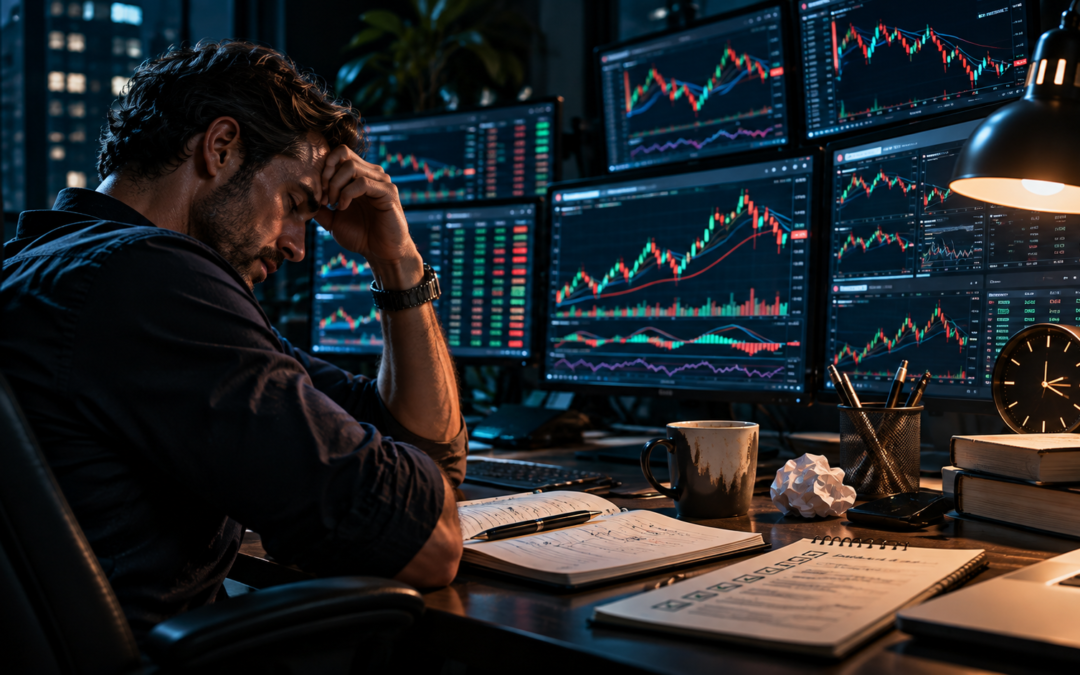
The Silent Saboteurs of the Trading Desk: Trading Fatigue and Overtrading
Successful trading is often portrayed as an exercise in intelligence, technical chart analysis and identifying a statistical edge. Yet in practice, many trading accounts do not fail because the trader lacks a valid strategy. They fail because the person executing that strategy becomes mentally depleted, emotionally reactive and increasingly inconsistent.
Two of the most destructive and interconnected forces in financial markets are trading fatigue and overtrading.
Trading fatigue is the gradual erosion of cognitive stamina, emotional regulation and analytical sharpness caused by prolonged market exposure, stress, disrupted sleep and excessive screen time.
Overtrading is often the behavioural consequence of compromised judgement. It involves entering positions without valid setups, forcing trades in unfavourable conditions, increasing position sizes impulsively to recover losses or exiting positions prematurely because of mental exhaustion.
Together, these behaviours create a vicious cycle.
Fatigue weakens impulse control, leading to unnecessary trades. Those trades produce inconsistent results and additional stress, which further deepens fatigue.
Understanding how these forces operate, and developing systematic safeguards against them, is essential for anyone seeking greater consistency in financial markets.
What Trading Fatigue Actually Does to the Brain
Trading requires continuous decision-making under uncertainty.
Every price movement, candlestick, news headline and unrealised profit or loss creates another decision to evaluate.
Is this setup valid? Should the stop-loss be adjusted? Is momentum fading? Is the market consolidating? Should I enter, exit or simply wait?
Even when a trader is not actively executing orders, constantly monitoring market conditions consumes mental energy.
As cognitive resources become depleted, several predictable changes can occur.
1. Declining Executive Function
The prefrontal cortex plays an important role in planning, impulse inhibition, risk calculation and decision-making.
Under sustained cognitive load and fatigue, these functions can become less effective.
Traders may begin prioritising immediate relief or stimulation over disciplined long-term decision-making.
Instead of following established rules, they become more susceptible to impulsive decisions and unnecessary trading activity.
2. Heightened Emotional Reactivity
Fatigue reduces the mental buffer between an external market event and an emotional response.
A routine stop-loss can suddenly feel personal. Missing a market movement creates urgency. A small upward price movement becomes an irresistible invitation to enter before the opportunity disappears.
Situations that would normally be evaluated objectively can begin triggering disproportionate emotional reactions.
3. Distorted Perception of Probability and Risk
A tired mind can struggle to distinguish meaningful market information from ordinary price fluctuations.
Consolidation may appear to be an imminent breakout. Random pullbacks may be mistaken for reversals.
Position-sizing rules and risk-management parameters that previously seemed reasonable may suddenly feel overly conservative or negotiable.
4. Tunnel Vision
Exhausted traders often become fixated on a single chart, timeframe or recent trading outcome.
They may overlook broader market structure, trading-session context or exposure across correlated instruments.
This narrowed perspective makes it increasingly difficult to evaluate the market objectively.
One of the most dangerous characteristics of trading fatigue is that it does not always announce itself clearly.
A trader may feel alert, particularly after consuming caffeine, while their concentration and decision-making ability have already deteriorated.
By the time exhaustion becomes obvious, several poor trading decisions may already have occurred.
How Overtrading Takes Hold
Overtrading is not simply about executing too many positions.
It is fundamentally about trading outside the boundaries of a strategy’s statistical edge, predefined plan or appropriate trading capacity.
It typically develops through several recognisable behavioural patterns.
1. Boredom and Action Bias
Financial markets spend considerable time consolidating, drifting or producing low-quality price movements.
Waiting patiently for high-quality trading opportunities requires discipline.
However, traders who become restless during quiet market conditions may begin lowering their entry standards simply to feel involved.
They manufacture opportunities where none may genuinely exist.
The desire to participate becomes more important than the quality of the setup.
2. Revenge Trading
Following a frustrating loss or a series of smaller losses, the desire to recover the money immediately can become overwhelming.
Instead of accepting normal trading variance, the trader increases trading frequency or position size in an attempt to force a quick recovery.
What should have remained a controlled drawdown can quickly become a much larger financial setback.
3. FOMO – Fear of Missing Out
Watching a sharp directional market movement develop without holding a position can trigger impulsive behaviour.
The trader enters late, fearing that the opportunity will disappear.
Unfortunately, these entries often occur when momentum is already becoming exhausted and a market pullback may be approaching.
Rather than waiting for a valid setup, the trader reacts to a movement that has already happened.
4. Chasing and Micromanaging
Overtrading can also happen within an existing position.
Examples include:
- Constantly moving stop-loss levels.
- Adding to positions without predefined criteria.
- Repeatedly switching between long and short positions.
- Reacting to every minor price fluctuation.
- Exiting trades prematurely because ordinary market movement creates anxiety.
Every small movement begins to feel significant, encouraging unnecessary intervention.
In all these situations, overtrading can erode a strategy’s mathematical expectancy.
Even a strategy with a positive statistical edge on high-quality setups can become less effective when additional low-quality or emotionally driven trades introduce unnecessary spreads, slippage, commissions and unfavourable risk-to-reward ratios.
The Compounding Dangers
The damage caused by trading fatigue and overtrading rarely remains isolated to a single trading session.
Instead, small mistakes can accumulate over weeks and months, gradually undermining both financial performance and psychological confidence.
1. Account Erosion Through Death by a Thousand Cuts
Catastrophic trading losses attract attention, but gradual account erosion can be equally destructive.
A few unnecessary trades each day, slightly wider stop-losses or repeated premature exits may appear insignificant individually.
However, these small mistakes accumulate.
Over time, they quietly drain trading capital and reduce the financial margin available to absorb legitimate losing trades.
2. Erosion of Trust in Your Own Trading System
Repeatedly breaking trading rules while fatigued creates a particularly damaging psychological trap.
The trader begins losing confidence in the strategy while simultaneously losing confidence in their own ability to execute it.
In this situation, traders often start blaming the system and modifying indicators, timeframes or trading parameters immediately after a difficult period.
They may abandon a fundamentally sound approach just before market conditions become favourable for its execution.
Instead of recognising that fatigue and poor discipline caused the problem, they mistakenly assume the underlying strategy is defective.
3. Sleep and Lifestyle Spillover
Trading fatigue does not end when the trading platform is closed.
Excessive screen time, late-night chart monitoring and unresolved stress from an overtraded session can affect sleep quality, family life and general well-being.
Poor sleep then creates another disadvantage when the next trading session begins.
The trader starts with reduced mental energy, making further mistakes more likely.
This creates a downward spiral in which personal well-being and trading performance increasingly affect one another.
4. Misreading Market Conditions
Fatigued traders can become particularly poor at recognising changing market environments.
They may continue forcing breakout or directional strategies into range-bound markets, or attempt to trade against strong trends because they struggle to accept the prevailing market direction.
Rather than adapting to market conditions, they begin fighting them.
These unnecessary trades expose capital to risks that could often have been avoided simply by recognising when conditions were unsuitable.
Practical Safeguards Against Fatigue and Overtrading
Willpower is a finite resource.
Relying entirely on the promise to “try harder to stay disciplined” is rarely sufficient when financial pressure, fatigue and emotional reactions begin influencing decisions.
More effective traders build structural safeguards into their trading routines.
The objective is to create boundaries that protect decision-making even when mental energy is running low.
1. Cap Trading Session Time and Screen Hours
Establish clear starting and finishing times for active trading.
Avoid remaining glued to live charts throughout the day simply because the markets are open.
Stepping away after a predefined trading window, particularly following major news events or volatile sessions, helps preserve mental energy.
2. Establish Hard Trade and Loss Limits
Define a maximum number of trades permitted during each session.
Also establish firm daily or weekly loss limits.
Once either boundary is reached, trading must stop.
These limits should be treated as mandatory protective measures, not flexible guidelines that can be ignored when the trader feels confident about recovering losses.
3. Use a Written Pre-Entry Checklist
Before entering a position, verify that the trade satisfies the objective requirements of the strategy.
A checklist should include:
- Valid trading setup.
- Appropriate market structure.
- Defined risk per trade.
- Clear invalidation level.
- Acceptable risk-to-reward ratio.
If you are too tired to evaluate these conditions honestly, you are too tired to take the trade.
4. Implement a Cooling-Off Rule After Losses
Introduce a mandatory 15- to 30-minute break following a losing trade or a series of losses.
Step away from the trading screen.
This interruption helps break the immediate emotional cycle and reduces the temptation to enter another position simply to recover lost money.
A short pause can prevent one frustrating trade from developing into an entire session of unnecessary losses.
5. Track Energy and Emotional State Alongside Trading Results
Your trading journal should record more than entries, exits and profit or loss.
Include information about:
- Sleep quality.
- Mental clarity.
- Emotional state.
- Trading-session duration.
- Significant periods of stress.
Over time, patterns may become apparent.
You may discover that your most expensive mistakes occur during particular hours, following poor sleep or immediately after emotionally difficult trading sessions.
This information can help identify personal weaknesses and improve your trading routine.
6. Embrace Sitting on Your Hands as an Active Decision
Doing nothing is often one of the most difficult decisions for an impatient trader.
However, remaining outside the market when conditions are unclear is not wasted time.
It is capital preservation.
Waiting patiently for high-quality trading opportunities is a fundamental trading skill, not a sign of hesitation or indecision.
The ability to recognise when not to trade can be just as valuable as recognising when to enter.
Conclusion: Protect Your Focus, Protect Your Capital
In financial markets, restraint is often harder than action, but it can be considerably more valuable.
Trading fatigue gradually weakens the ability to make sound decisions, while overtrading turns that reduced clarity into unnecessary financial exposure.
Protecting mental energy and enforcing clear boundaries around when and how often you trade are not optional additions to a trading strategy.
They are fundamental components of disciplined execution.
A trading system can provide structure, identify potential opportunities and establish the rules governing a position.
But the trader must still have the mental clarity and discipline to follow those rules.
Guard your focus. Respect your limits. Give your trading edge the opportunity to work without unnecessary interference.