
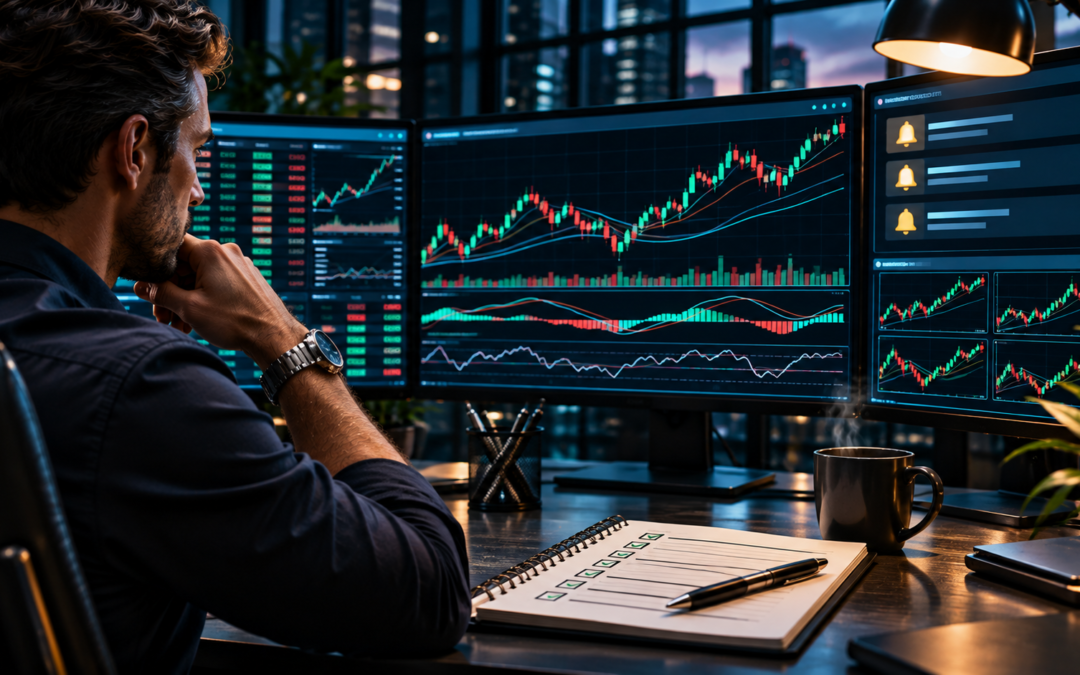
Building a Structured Edge in the Stock Market with Tsunami Systems and Strategies
Trading the stock market has never suffered from a shortage of information.
Every trading session brings earnings announcements, macroeconomic headlines, sector rotations, order-flow changes and countless competing technical indicators. For most retail and active traders, the real challenge is not finding more information. It is turning an overwhelming amount of market data into a repeatable, disciplined decision-making process.
Tsunami Systems & Strategies approaches this challenge through a straightforward philosophy: replace emotional guesswork with a structured, rules-based analytical workflow.
Through its Tsunami Pro Trader™ framework, the company aims to bring together technical analysis, automated market scanning, trading alerts and structured strategy rules to help traders navigate financial markets more systematically.
No technical system or trading software can guarantee profits, and trading inherently carries significant financial risk. However, understanding the mechanics and workflow behind Tsunami Systems & Strategies provides a clearer picture of how its approach is designed to support more disciplined trading decisions.
1. The Core Problem: Information Overload and Emotional Execution
Anyone who has spent time following equity markets understands how quickly information overload can influence trading decisions.
A stock suddenly rises following a news announcement. Technical indicators produce conflicting signals across different timeframes. A trader hesitates or, worse, chases an extended price movement out of fear of missing out.
Conversely, a sharp market pullback can trigger premature exits or revenge trading.
Tsunami Systems & Strategies frames its philosophy around this challenge:
“Trade with a System. Not With Emotion.”
Rather than requiring traders to manually interpret scattered charts and competing opinions, the Tsunami Pro Trader™ framework combines technical indicators built around the ProRealTime charting platform with the Tsunami Pro Strategy™.
For stock market participants, the intended advantage begins with process consistency.
Instead of reacting to every market movement, traders can evaluate market activity through a defined set of analytical layers before committing capital.
2. How the Tsunami Workflow Creates a Practical Edge
According to Tsunami Systems & Strategies, its trading ecosystem follows a structured sequence designed to move traders from market observation towards informed execution.
Several interconnected components contribute to this workflow.
24/7 Market Scanning
Rather than spending hours manually working through watchlists, the system continuously scans financial instruments to identify potential trading opportunities as market conditions develop.
For traders following stocks and stock CFDs across different trading sessions, automated scanning can help narrow a broad universe of instruments down to potential candidates for further analysis.
Layered Technical Analysis
Tsunami Pro Trader™ combines technical indicators on the ProRealTime platform with structured strategy rules to evaluate market behaviour.
Rather than relying on one isolated oscillator or indicator, the framework emphasises multiple layers of market information to help traders interpret:
- Market momentum.
- Trend structure.
- Directional conditions.
- Potential market inflection points.
This layered approach is intended to provide a more structured view of market conditions before a trading decision is made.
Real-Time Alerts Across Multiple Channels
Trading opportunities do not always develop when a trader is sitting in front of a computer.
Tsunami’s alert functionality is designed to deliver notifications through the trading platform, email and mobile devices.
For traders who cannot monitor multiple screens throughout the day, timely notifications can help reduce continuous screen monitoring while keeping them informed when potential setups develop.
Defined Entry, Exit and Risk Rules
One of the central principles behind the Tsunami approach is moving beyond raw market information towards clearly defined trading decisions.
The framework applies structured strategies with predetermined entry and exit conditions alongside consistent risk management.
This helps establish a more repeatable process rather than relying entirely on subjective interpretation.
Brokerage Integration
The Tsunami Systems & Strategies website highlights integration with Trade Nation, connecting its trading intelligence and strategy framework with brokerage infrastructure.
The available instrument categories include:
- Stocks.
- Contracts for Difference (CFDs).
- Forex.
- Commodities.
- Cryptocurrencies.
This provides a broader trading environment across multiple financial markets, subject to the applicable platform and brokerage requirements.
3. Where the Edge Comes From – and Its Real-World Boundaries
In financial markets, a trading edge should not be viewed as a magic button or a guarantee of profitability.
It is better understood as a repeatable structural or behavioural advantage that can improve decision-making and risk management over a sufficiently large sample of trades.
When applied to stock market trading, a framework such as Tsunami Pro Trader™ aims to create advantages in several areas.
Faster Filtering and Reduced Screen Fatigue
Manually scanning financial markets is time-consuming and can become mentally exhausting.
By automating initial market monitoring and identifying potential setups when predefined conditions are met, a structured system can allow traders to spend more time evaluating market context and managing risk rather than continuously searching through charts.
Objective Structure Over Impulsive Reactions
Predefined strategy parameters and entry and exit conditions can help counter impulsive decision-making.
When a stock experiences a sharp price movement, a rules-based framework provides a checklist for assessing whether a potential setup remains valid or whether the price has already moved too far.
This encourages decisions based on established criteria rather than emotional reactions to price movements.
Support for Newer and Experienced Traders
Tsunami Systems & Strategies positions its tools and educational resources, including guides, webinars and support, for traders across different experience levels.
Newer traders can benefit from having a structured framework for understanding chart conditions and risk management.
More experienced traders can use systematic alerts and technical indicator frameworks to streamline their market analysis or complement an existing trading routine.
The objective is to provide a consistent analytical framework that can be incorporated into different trading approaches.
4. Important Considerations When Trading Stocks
A balanced assessment of any trading system requires an understanding of its limitations.
Even sophisticated technical frameworks cannot eliminate market uncertainty.
There are several important considerations traders should keep in mind.
Technical Indicators Provide Context, Not Certainty
Technical indicators and strategy rules interpret historical price movements and market data.
They cannot reliably predict unexpected earnings announcements, regulatory changes, sudden liquidity shocks or other events that can significantly affect individual stocks.
Indicators should therefore be treated as analytical tools rather than guarantees of future market behaviour.
Market Conditions Matter
Trend- and momentum-oriented trading frameworks can behave differently depending on prevailing market conditions.
A strategy that performs well during strong directional movements may encounter different challenges during choppy, range-bound or news-driven sessions.
Knowing when not to trade, or when to adjust expectations, is just as important as identifying a potential trading opportunity.
Execution and Risk Management Remain the Trader’s Responsibility
Tsunami Systems & Strategies makes an important distinction regarding trading responsibility:
The final decision remains with the trader.
Position sizing, adherence to stop-loss levels, spreads, commissions and instrument selection all influence real-world trading outcomes.
This is particularly important when comparing cash equities with leveraged instruments such as CFDs, where losses can develop quickly if exposure is not properly controlled.
A structured system can support better decision-making, but responsible execution and risk management remain essential.
Understanding the Access Model
Tsunami Systems & Strategies advertises access to its Tsunami Trading System without a subscription fee, licence fee or monthly charge through its enquiry and brokerage-alignment model.
Prospective users should confirm the applicable terms, platform requirements, brokerage arrangements and risk disclosures directly with the company before opening an account or committing live trading capital.
Understanding how the service is accessed is an important part of evaluating whether the overall arrangement is appropriate.
5. Putting It Together for Stock Market Traders
Approaching stock market trading through Tsunami Systems & Strategies is fundamentally about operational discipline.
By bringing together ProRealTime-based technical indicators, automated market scanning, real-time alerts, structured strategies and educational support under the Tsunami Pro Trader™ framework, the system aims to simplify an otherwise complex market environment.
For stock traders, the greatest value comes from treating these tools as a decision-support framework rather than a replacement for independent judgement.
Use market scans and alerts to identify potential opportunities. Evaluate how each setup fits current market conditions and the liquidity of the instrument being considered. Apply appropriate position sizing and maintain disciplined risk management throughout the process.
No trading system removes the possibility of losses.
However, replacing scattered information and emotional reactions with a structured analytical workflow can provide a more consistent foundation for evaluating trading opportunities.
Ultimately, a sustainable trading approach requires more than access to market information.
It requires a process for interpreting that information, making objective decisions and managing risk.
Trade with a System. Not With Emotion.
Disclaimer: This article is intended for informational and educational purposes only. It does not constitute financial, investment or trading advice. Trading stocks, CFDs and other financial instruments involves significant risk of loss. Always understand the risks and conduct your own assessment before trading.